

Legends Performance Lab · Karachi
Measure what you are built on.
Pakistan's first physician-led performance diagnostic. Eight physical qualities, measured with instrumentation, in one ninety-minute session. You leave with a report that tells you the truth about your body, and the one thing to work on next. For athletes, children, and adults who train.
8
Qualities measured, not estimated
1/1000
Of a second. The precision of the timing gates.
90
Minutes. One session, start to debrief.
0
Scores we invented. Every
benchmark names its source.
Who this is for
The same assessment.
Four very different reasons to have it.
The tests do not change between a national sprinter and a sixty-eight-year-old. What changes is which qualities matter, what a good result looks like, and where the training goes. That is a judgement, and a physician makes it.
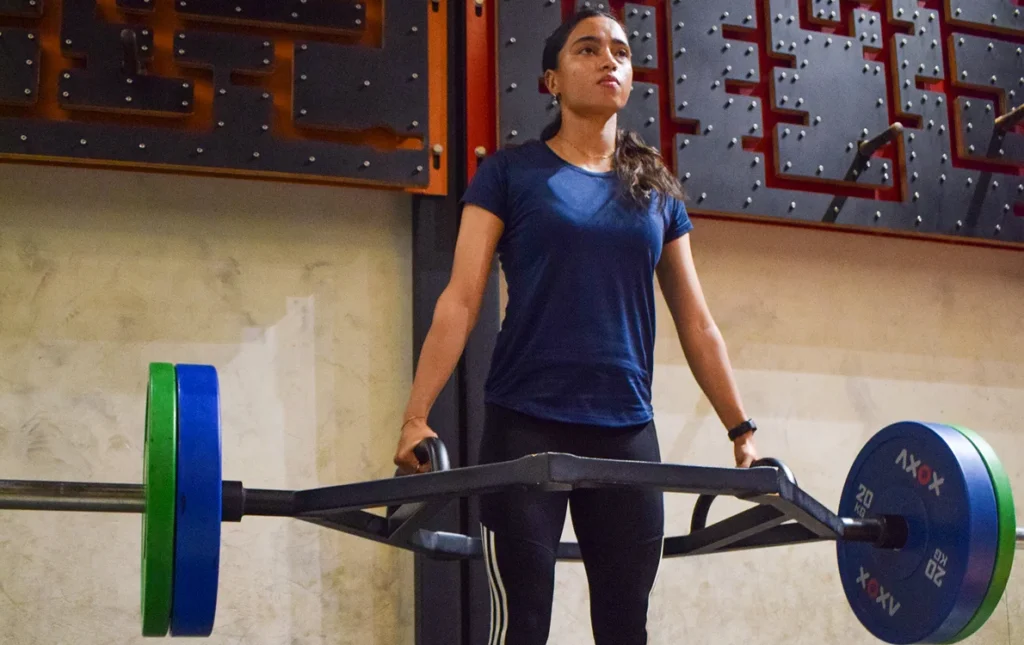

The serious amateur
You train around a job, and nobody has ever told you anything specific about your own body.
Padel, tennis, football, running, the gym. You train several times a week around a job, you are competitive about it, and nobody has ever told you anything specific about your own body. You are also the person most likely to find something here that changes how you train.

The young athlete, and their parent
A birth certificate is the least useful thing we know about a child.
Chronological age tells you almost nothing about what a young body should be doing. Biological development tells you everything, and getting it wrong through a growth spurt is how promising children get injured out of their sport. Choose your track below.

The adult protecting independence
The qualities that decide your seventies are measurable in your fifties.
Strength, power, grip and balance decide whether you carry your own shopping, get off the floor unaided, and recover from a stumble instead of falling. All four decline quietly, all four respond to training at any age, and all four are measurable now. If you are returning to activity, the maximal tests are substituted for validated functional ones. The physician decides which on the day, after screening.

The competitive athlete
You are not undertrained. You are probably training the wrong quality.
You have plateaued, or you suspect you are working extremely hard on the quality you are already good at while the one actually capping you goes untouched. Almost nobody is limited across the board. Most are limited by one thing and have been training around it for years.
Every gym in Pakistan promises a result. Almost none of them measure one.
You have been coached your whole life on opinion. Someone watched you move and told you what you were. Nobody showed you a number, nobody told you which single quality was holding you back, and nobody measured you again to find out whether anything changed.
THE RETEST
Every programme here ends where it began: the same gates, the same mat, the same eight qualities, under the same conditions. A promise costs nothing to make. A retest can prove one, and it can also disprove one, which is why so few people offer it.
A measurement is not a verdict. It is a position on a range, on one morning, against a named group of people. What we are looking for is your limiter: the one quality that, if it improved, would move you the most. Finding it is the point of the session.
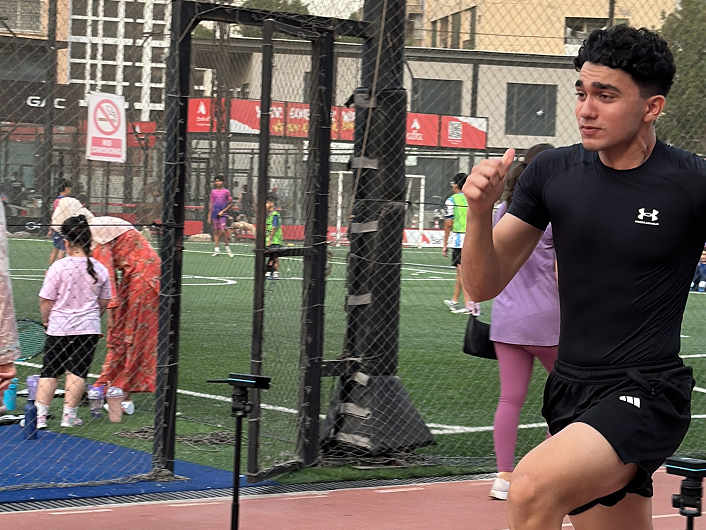
The eight qualities

Acceleration
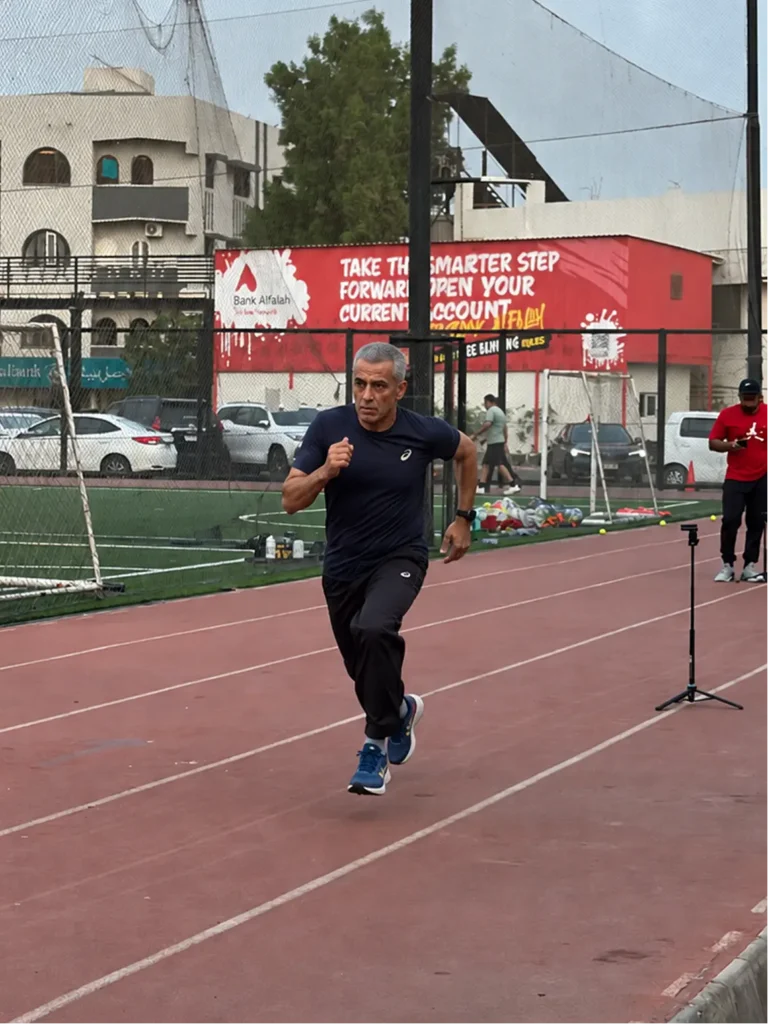
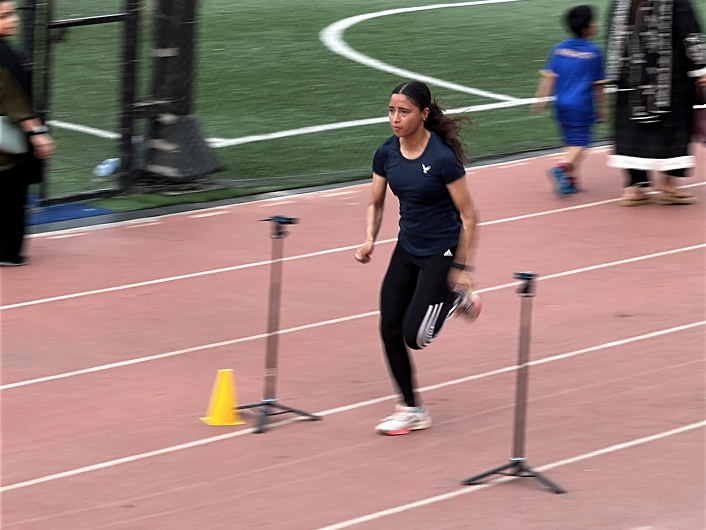
How explosively you get moving from a standstill. The first few steps decide most sporting actions, and they are trained differently from top speed. Measured with laser gates to a thousandth of a second.

Maximal speed
How fast you are once you are already moving. Some people explode out of the start and run out of gears. Others are slow to start and devastating at full speed. Two athletes can post the same sprint time for opposite reasons.

Vertical power
Force delivered upward at speed. The engine behind every jump, every takeoff, and every contest in the air. Measured on an instrumented jump mat.

Reactive strength
How quickly you turn a landing into a spring. The elastic quality behind fast feet, quick cuts and repeated jumps. It is the most transferable athletic quality there is, and the one almost nobody trains deliberately.

Horizontal power
Force projected forwards rather than upwards. It mirrors the mechanics of the first strides of a sprint, and it is a genuinely different quality from jumping high. Plenty of people have one and not the other.

Maximal strength
Your force ceiling: the largest force your body can produce. We read it from the speed of the bar as you lift, which means we never ask you to attempt a true maximum in order to find out.

Grip strength
One of the most validated health markers in all of medicine, and a proxy for whole-body strength. The difference between your left and your right tells us as much as the number itself.

Change of direction
How fast you stop, plant and go again. The quality that decides most points on a court and most duels on a field, and the one that linear speed testing misses completely.
These eight are our standard battery. Where a sport makes specific demands, motorsport for example, we rebuild the assessment around what that sport actually requires.
Inside the diagnostic
Ninety minutes. Eight test blocks. Nothing done for the sake of it.
Every test in this session earns its place. Each one isolates a quality the others cannot see, and each one was chosen over the alternatives for a reason we will happily explain to you on the day.
The order is fixed and never varies. Every test creates fatigue that would contaminate the next one if run out of sequence, so we move from the most fatigue-sensitive measurements to the most fatiguing. A number taken in the wrong order is not a slightly worse number. It is a wrong one, and it is worse than no number at all, because you would act on it.
01 Body measurements The context everything else is read against.
01
Body measurements
The context everything else is read against.
What it measures. Height, body mass, seated height, and the proportions between them.
Why it comes first. Almost every other result only means something relative to your body. A jump distance means one thing for a tall athlete and something else for a short one. Strength is read against bodyweight. Power scales with mass. Without this, the rest of the numbers float free of context.
Why it matters most for young athletes. Two fifteen-year-olds of the same age can be biologically years apart. One may be through their growth spurt and the other nowhere near it, and their training needs are completely different. Chronological age hides this entirely. These measurements let us estimate where a young athlete actually sits in their own development, which is the single most useful piece of information for training a teenager safely.
We record body mass index for health screening context and nothing else. It is a population screening tool, not a measure of body fat, and a muscular athlete will read high on it while carrying very little. It is never shown to you as a comment on your body and it is never published.
02 Grip strength Ninety seconds, and the most validated health marker in the session.
02
Grip strength
Ninety seconds, and the most validated health marker in the session.
What it measures. The maximum force each hand can produce, measured separately, and the difference between them.
Why we run it. Grip strength is one of the most robustly validated biomarkers in medicine. Across decades of research and across populations, it independently predicts all-cause mortality, cardiovascular mortality, disability and age-related muscle loss. For an athlete it doubles as a proxy for whole-body neuromuscular strength.
What the difference tells us. In racket and throwing sports one side is loaded far harder than the other, year after year. A widening gap between your two hands is a genuine early warning for the overuse injuries that end careers in those sports. This is why we measure each hand separately rather than taking the better one and moving on.
Anything we find on either side of this measurement that looks clinical goes into your private record and is discussed with you face to face. It is never published, whatever you consent to.
03 The jump series Five separate measurements, because explosiveness is not one thing.
03
The jump series
Five separate measurements, because explosiveness is not one thing.
What it measures. Vertical power, the elastic contribution to that power, reactive strength, left to right symmetry, and reactive endurance. All on an instrumented mat rather than by eye or against a wall.
Why five jumps and not one. Because a single jump height tells you almost nothing about why. Two athletes can jump the identical height for completely opposite reasons. One is producing enormous raw force slowly. The other is producing less force but recycling elastic energy brilliantly. They need opposite training. A single number cannot tell them apart, and prescribing from it is a coin toss.
The finding that earns the fee. Read together, these jumps separate the athlete who is strong but stiff from the athlete who is springy but weak. Someone who jumps high, shows very little elastic contribution, and reacts slowly off the ground does not need more load in the gym. They need reactive work, and almost every coach they have ever had will have told them the opposite.
The single-leg measurements. Sport is played on one leg. Both legs are measured separately, and the gap between them is calculated. A meaningful gap is a flag worth addressing early, and it is the most likely place in the whole session for something useful to appear in an athlete who otherwise looks fine.
A flag is a finding, not a diagnosis. A gap on a first assessment with no injury history is something we watch and address, not something to be frightened of. Left-right findings stay in your private record.
04 Standing broad jump The most direct field measure of how you accelerate.
04
Standing broad jump
The most direct field measure of how you accelerate.
What it measures. How far you can project yourself forwards from a standing start. Horizontal power.
Why it is not the same as jumping high. The mechanics mirror the first strides of a sprint: force driven backwards and down through hip, knee and ankle, rather than straight up. It captures something the vertical jumps miss entirely, which is why plenty of athletes with an impressive vertical are slow out of the blocks, and why we measure both rather than assuming one predicts the othe
Why it stays in the battery. It needs nothing but a marked line and a tape, it is validated, and it is among the strongest simple predictors of sprint acceleration that exists. Not every useful measurement requires an instrument.
05 Sprint profile Not how fast you are. Where in the run you are fast.
05
Sprint profile
Not how fast you are. Where in the run you are fast.
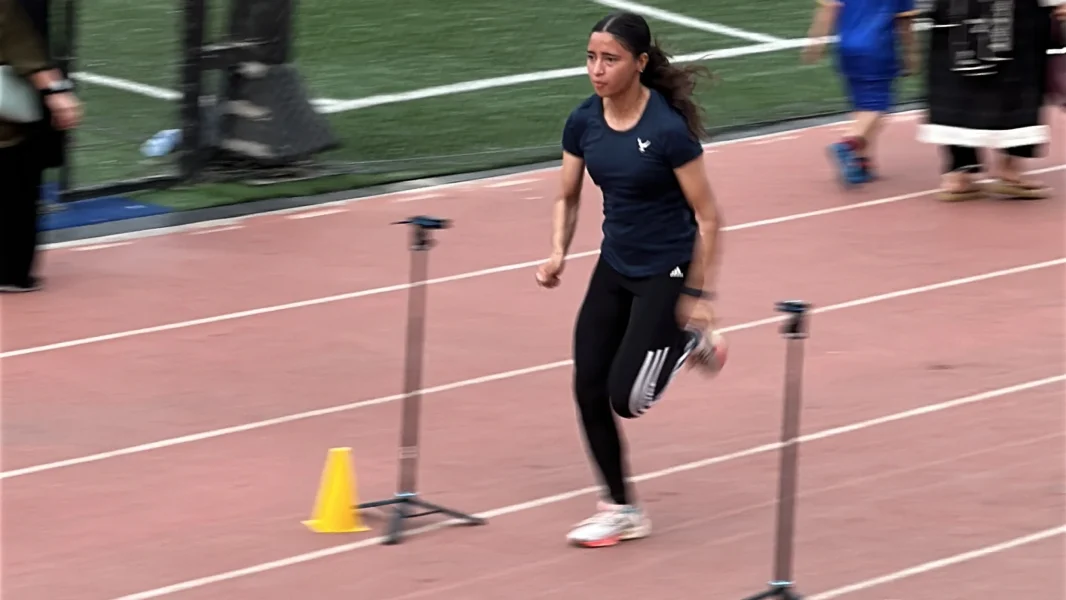
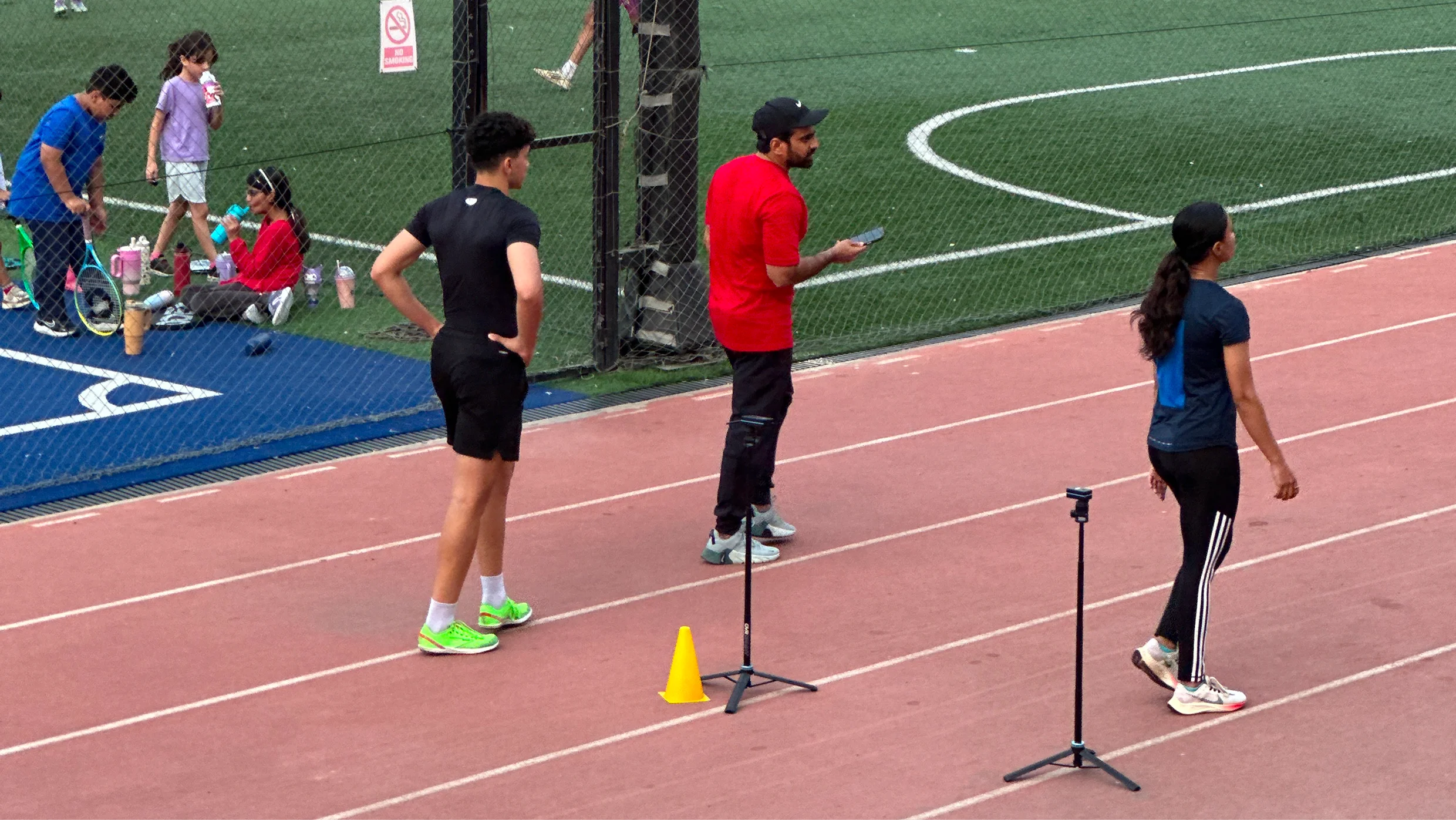
What it measures. Your acceleration from a standstill, and your speed once already moving, timed separately through laser gates to a thousandth of a second.
Why the split matters more than the total. A single sprint time hides the thing you need to know. Acceleration and top speed are different physical qualities with different mechanics and completely different training. Some athletes explode out and then run out of gears. Others are slow to start and devastating once they are moving. Both can post the same final time and need opposite programmes. Timing the phases separately is the entire reason for owning the gates.
Why a phone or a stopwatch is not a substitute. Human reaction time alone introduces error large enough to swamp the difference we are looking for. Over the distances that decide sport, the change worth acting on is smaller than the error a person with a stopwatch produces. If the instrument cannot resolve the change, the measurement is decorative.
06 Change of direction Stop, plant, go again. The quality linear testing cannot see.
06
Change of direction
Stop, plant, go again. The quality linear testing cannot see.
What it measures. How quickly you decelerate, change direction and re-accelerate, in both directions, through a timed shuttle.
Why it is separate from speed. Deceleration is its own physical quality and it is trainable in its own right. Braking loads are far higher than accelerating ones, which is why so many non-contact injuries happen while stopping rather than while sprinting. Fast athletes are frequently poor at stopping, and until you measure it separately you will never know which kind of athlete you have.
Why we run both directions. Almost everyone is better turning one way than the other. Court and field athletes do not get to choose which way the game asks them to turn.
Not every athlete runs this. A sprinter or a rower has no meaningful change-of-direction demand, and testing it would produce a number without a use. The battery is fitted to the sport, not the other way around.
07 Velocity-based strength Your force ceiling, found without ever asking you to attempt a blind maximum.
07
Velocity-based strength
Your force ceiling, found without ever asking you to attempt a blind maximum.
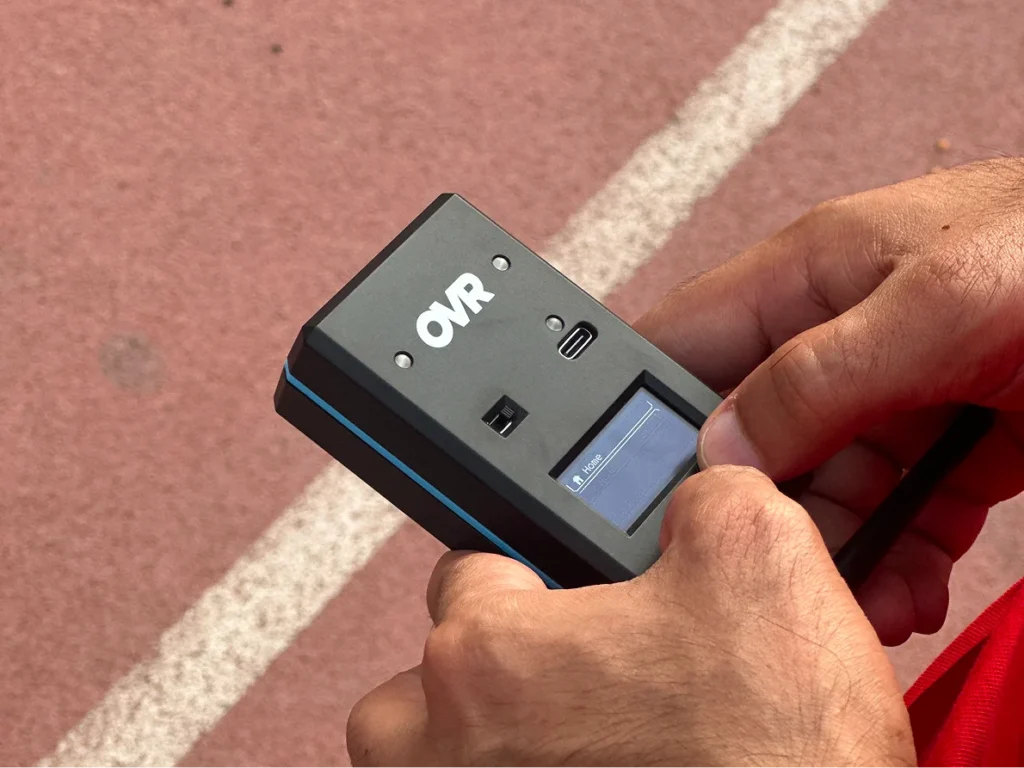
What it measures. Maximal strength, read from a sensor that tracks how fast the bar moves under progressively heavier loads.
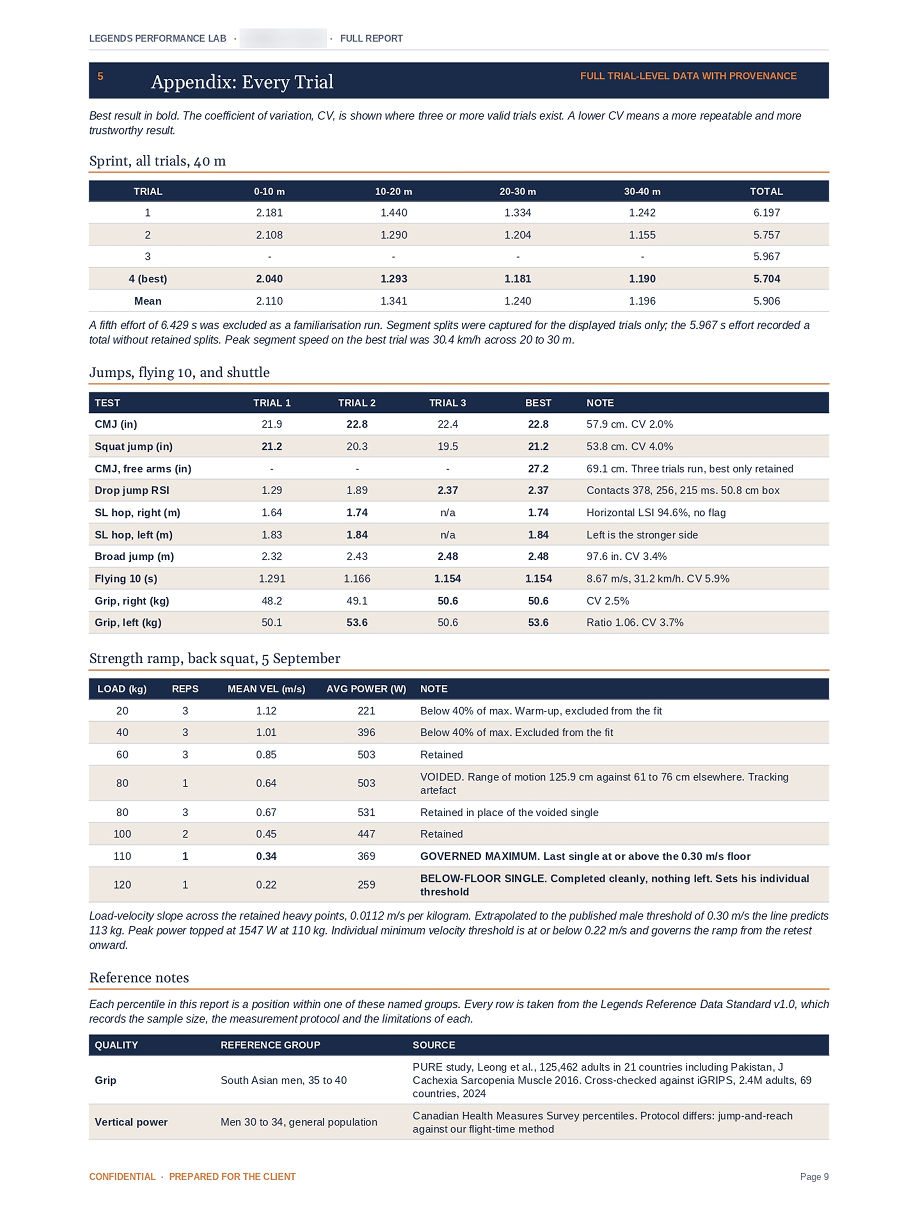
Why we never ask for a blind maximum . A one-rep maximum on an unknown body in a first session is an unnecessary risk with no compensating benefit. Instead we read the relationship between load and bar speed. On a first visit that is where it ends. For an athlete who already trains the lift and has been screened, the ramp continues while the bar is still moving fast enough, and stops the moment it is not. You never go to failure, you never grind out a rep, and nothing is decided by how much you feel like proving that day.
What it tells us beyond the number. The shape of that relationship is more revealing than the ceiling. It tells us whether you are limited by raw force or by the ability to express force quickly, and those two findings lead to completely different programmes. This is also what makes every subsequent training session governable: once we know your profile, load can be set by how fast the bar is actually moving on the day rather than by a percentage decided weeks earlier when you were a different person.
Why it goes last. It is the most fatiguing block in the session and the least affected by fatigue, so it can absorb everything that came before it without distorting the result.
08 The physician's observation The part that is not a number, described honestly.
08
The physician's observation
The part that is not a number, described honestly.
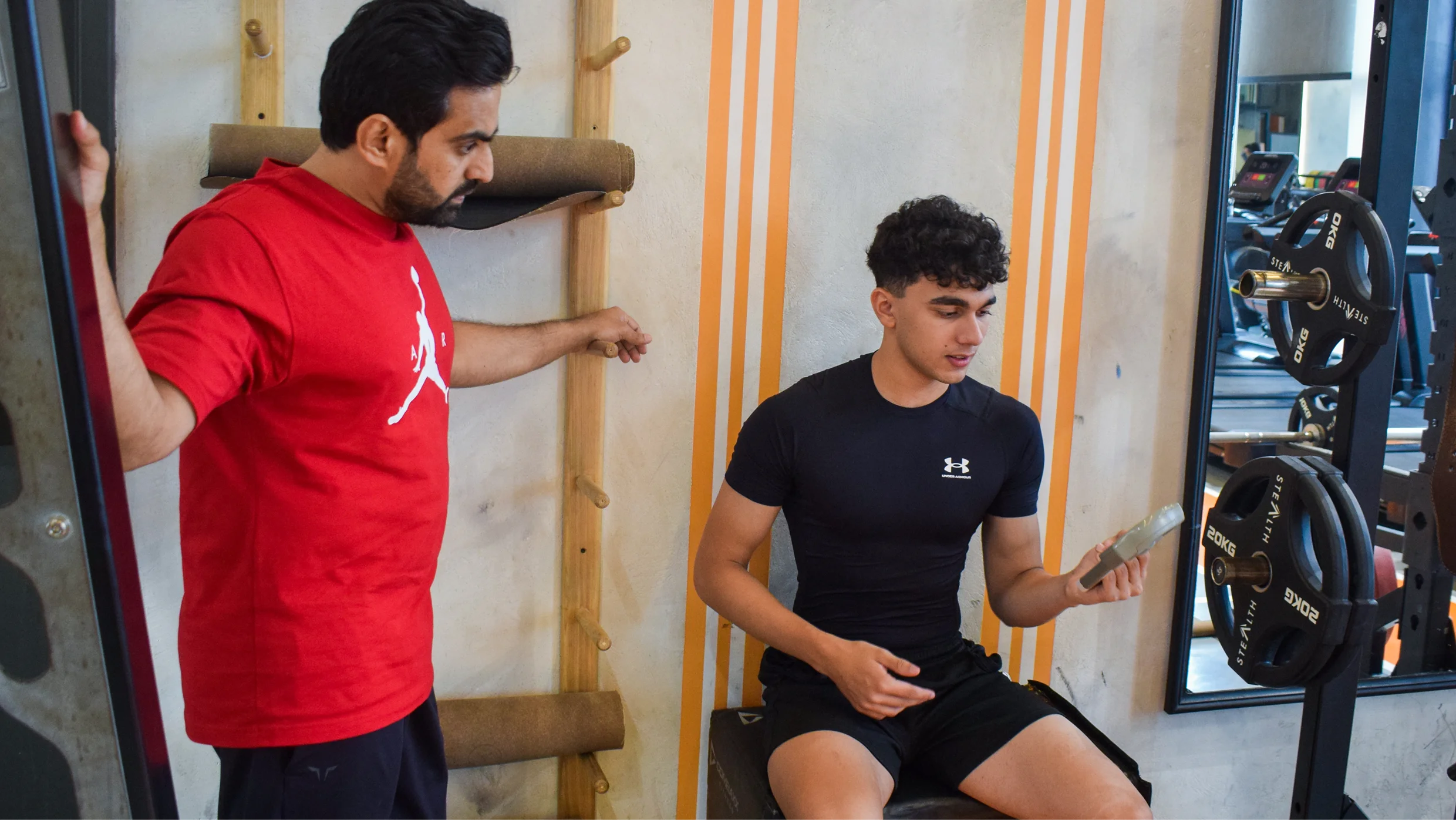
What it is. Throughout the session, as you squat, jump, sprint and turn, a doctor is watching how you move. Asymmetries, a knee that travels inward under load, a restricted hip, a guarded landing. These observations go into your report.
What it is not. It is not a scored movement screen presented as biomechanical analysis. Proper movement analysis requires force plates and three-dimensional motion capture, and we do not own them yet. So we will tell you plainly what this is: a physician's clinical observation, which is exactly what a doctor does in a consulting room, and which is worth having. We will not dress it up as something more precise than it is.
This is also where duty of care sits. If something appears during the session that concerns the physician, it is raised with you and referred on. That obligation overrides the schedule, the camera and your own preference to carry on.
What you walk out with
A report, and somebody to explain it to you.
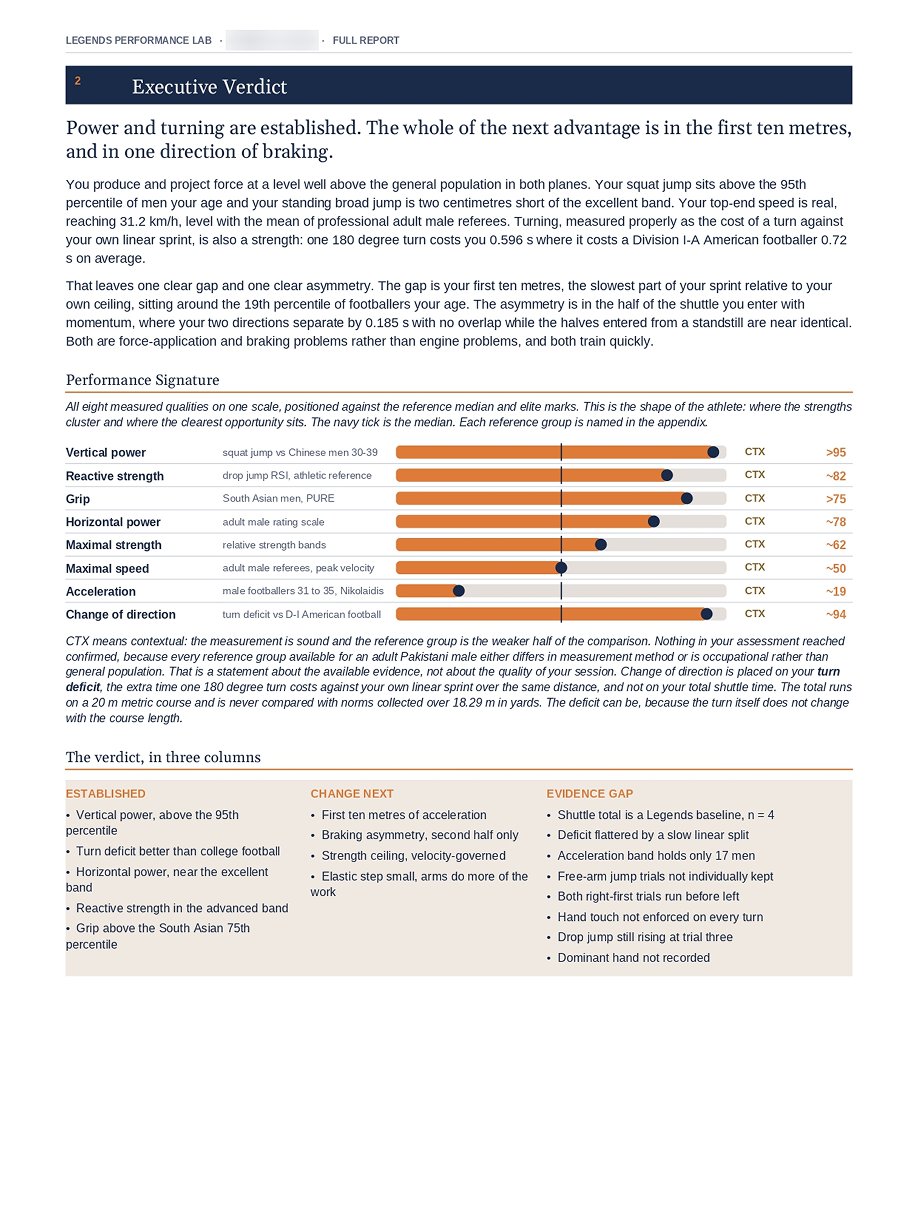
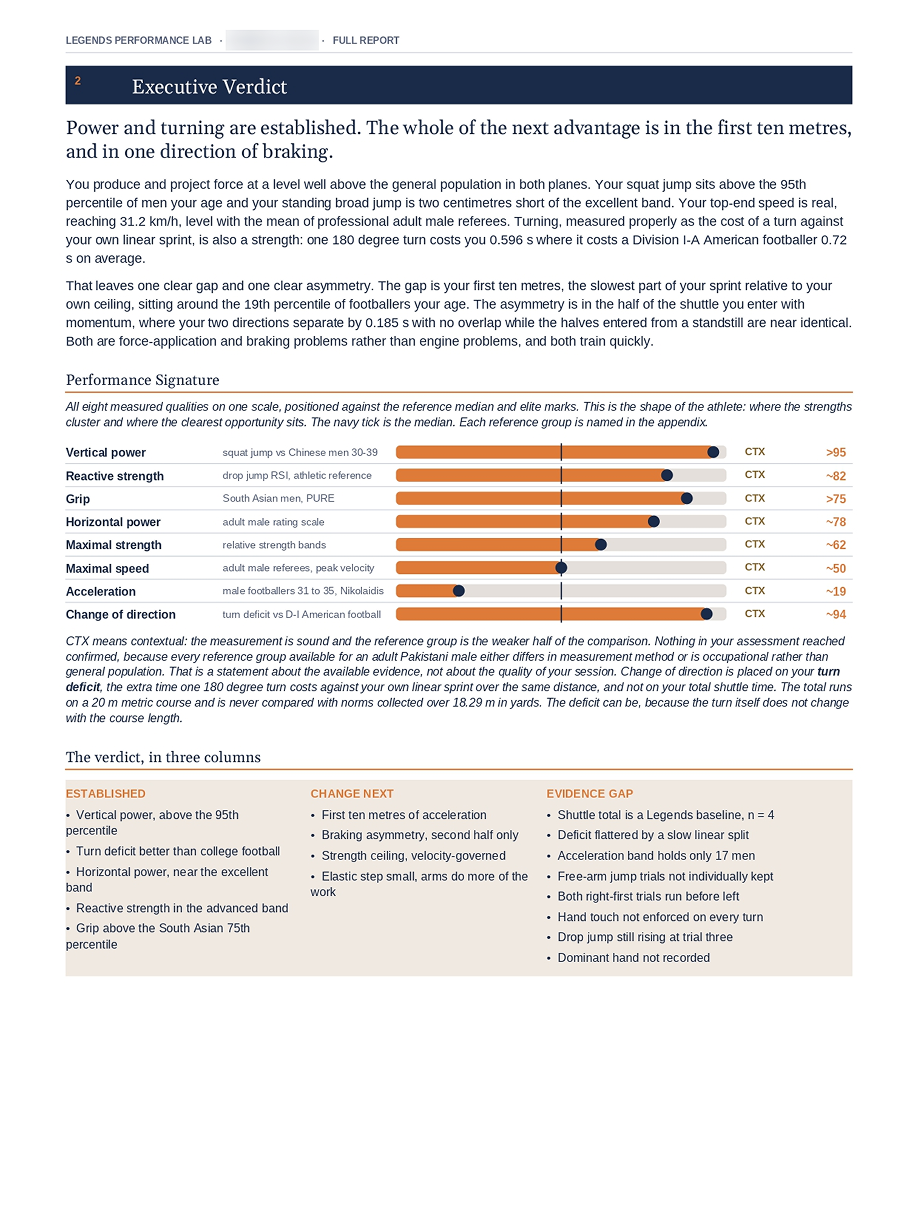
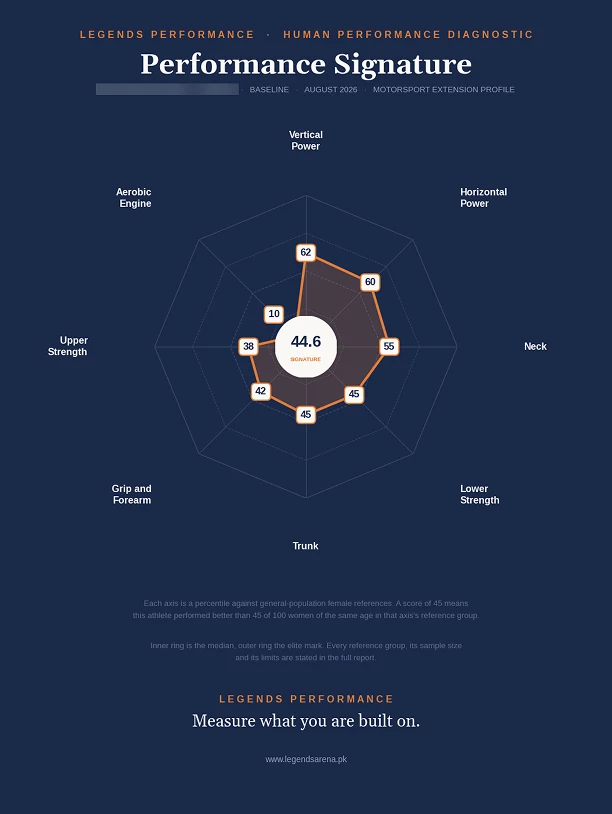
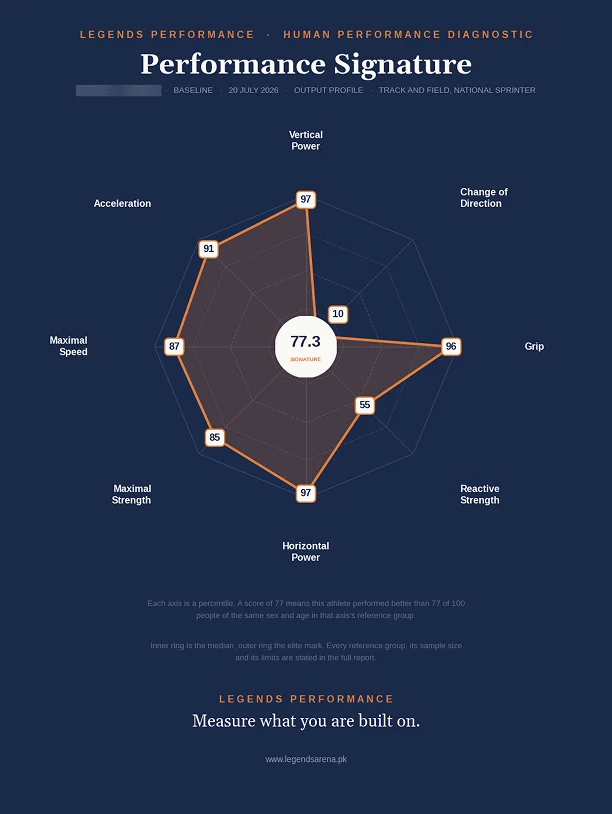
- Your Performance Signature. Every quality plotted against a named reference group, so you can see the shape of your own profile at a glance. Not a grade. A shape, with the strong edges and the flat ones both visible.
- A confidence rating on every single measurement. Confirmed, contextual or provisional. We tell you which numbers to trust completely, which are directionally sound, and which are a signal to confirm at the retest. No other report you have been handed has done this, and it is the difference between data and decoration.
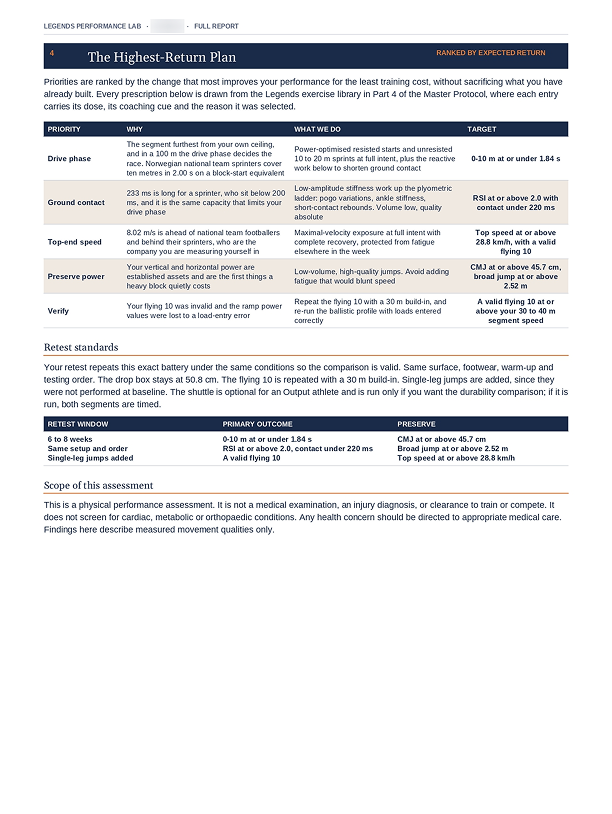
- Your limiter, named. The one quality to work on next, with the reasoning laid out so you can disagree with it.
- A face-to-face debrief. The report is not emailed to you to decode alone. A doctor sits across a table and takes you through it, including anything clinical, which stays private and never appears in anything public.
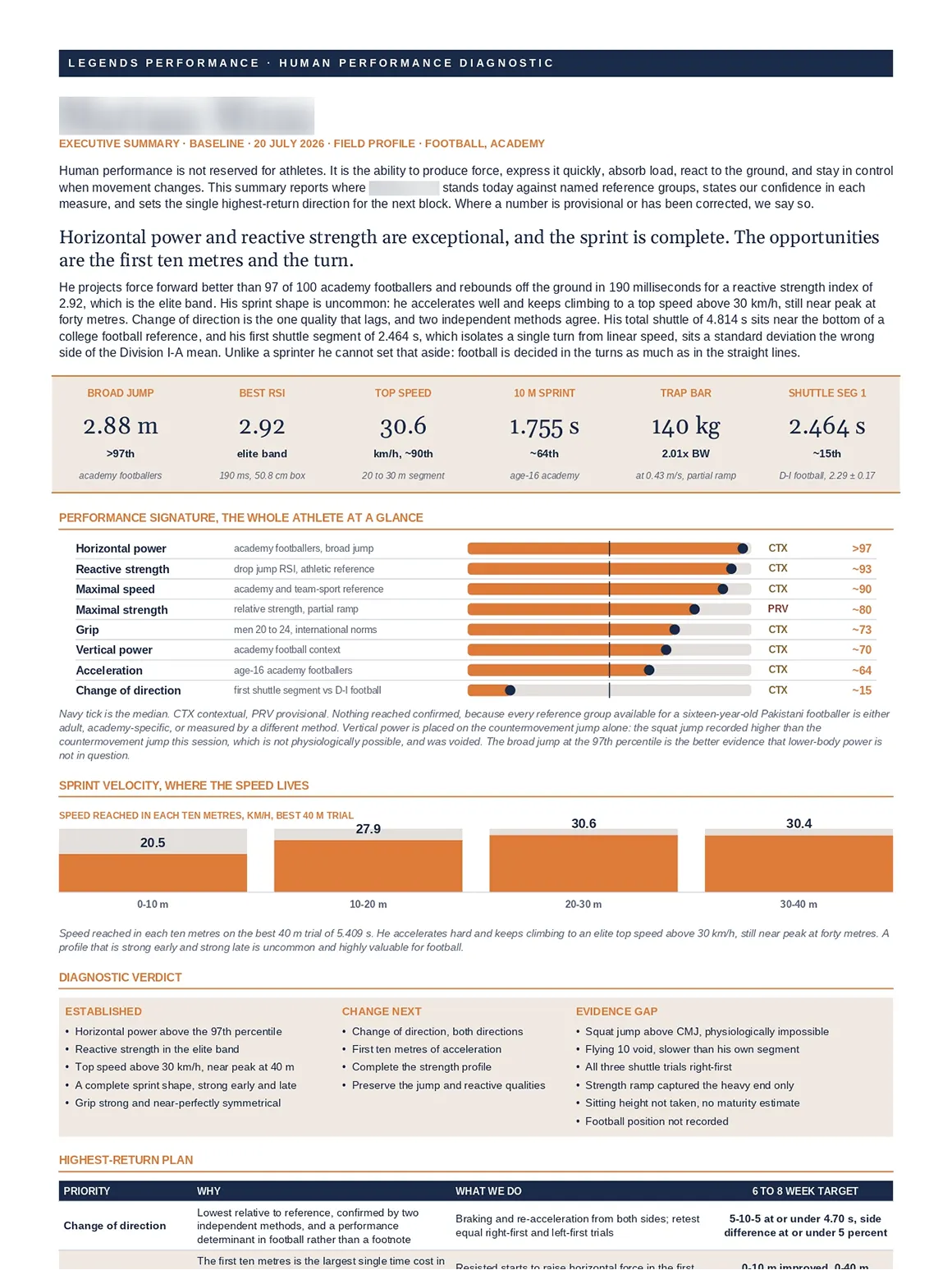
Explore Performance Snapshots
Browse key report snippets highlighting assessment results, progress, and performance insights.
The honest part
Here is what we cannot measure yet.
With a doctor's name on the report, we measure things properly or we do not claim them at all. What we do own is a laser sprint system on five gates, an instrumented jump system, velocity-based strength assessment and clinical grip dynamometry. Here is the rest of the list, which we would rather you read now than discover afterwards.
Not in the session
Why not, and what we do instead
Rotational power
The quality behind a padel smash, a squash forehand and a bowling action. Measuring it properly needs a sports radar reading throw velocity. Throw distance, which is what everyone else uses, depends as much on technique and effort as on power, so it is not a valid substitute. We do not own the radar, so we do not claim the domain.
Three-dimensional movement analysis
What would turn the physician's observation into a scored, defensible biomechanical assessment. Until then, we describe that observation for exactly what it is: a doctor watching you move, which is worth having and is not the same thing.
Laboratory aerobic testing
We do not have a metabolic cart or an instrumented treadmill, so we do not report a directly measured VO2 maximum. Where aerobic capacity matters for your sport we assess it using validated field protocols and report the result as an estimate, with the protocol named on your report so you know precisely what produced the number.
Body composition
Not part of this assessment. It is a different question from performance, the methods that are cheap are not accurate and the methods that are accurate we do not own, and a poor body composition number does more harm than no number at all.
The areas below are not currently part of this assessment. Here is why, and what we measure instead.
Rotational power
The quality behind a padel smash, a squash forehand and a bowling action. Measuring it properly needs a sports radar reading throw velocity. Throw distance, which is what everyone else uses, depends as much on technique and effort as on power, so it is not a valid substitute. We do not own the radar, so we do not claim the domain.
Three-dimensional movement analysis
What would turn the physician's observation into a scored, defensible biomechanical assessment. Until then, we describe that observation for exactly what it is: a doctor watching you move, which is worth having and is not the same thing.
Laboratory aerobic testing
We do not have a metabolic cart or an instrumented treadmill, so we do not report a directly measured VO2 maximum. Where aerobic capacity matters for your sport we assess it using validated field protocols and report the result as an estimate, with the protocol named on your report so you know precisely what produced the number.
Body composition
Not part of this assessment. It is a different question from performance, the methods that are cheap are not accurate and the methods that are accurate we do not own, and a poor body composition number does more harm than no number at all.
Every operator in this market will tell you what they can do. This is the list of what we cannot. When the equipment arrives, these join the session and we will say so. Until then you have our word on where the edges are, which is worth considerably more than a longer list would be.
Three tracks. One assessment.
Everything above is the same for everyone. What follows is not. Choose the track that describes you and read what changes: what we are looking for, what a good result means, and where the training goes afterwards.
You are not undertrained. You are probably training the wrong quality.
Most athletes who plateau are not lazy and are not short of volume. They are working extremely hard on the quality they are already good at, because it is the one that feels productive, while the quality actually capping their performance goes untouched for years.
The limiter is one thing, not everything
Almost nobody is limited across the board. A sprinter with excellent top speed and poor first-step acceleration needs horizontal force, not more running. An athlete who jumps high but reacts slowly off the ground needs reactive work, not heavier squats, and will have been told the opposite by every coach they have had.
The whole point of measuring eight qualities separately is that these profiles look identical from the outside and require opposite programmes.
Load is governed by velocity, not by percentages
A percentage of your maximum was decided on a day you were a different person. You slept badly, you had a hard track session this morning, you are three weeks into a competition block. The number on the plan does not know any of that.
Every loaded set here is governed by how fast the bar is actually moving. When the speed falls below the floor for the quality being trained, the set ends. Not when the plan says, and not when your ego says. There is no grinding, because a ground-out repetition trains fatigue rather than the quality you came for.
Somebody has to own your total load, and it should be a doctor
If you run with a coach in the morning and lift in the evening, two people are each prescribing a hard day without either of them seeing the whole picture. That is the fastest route to overtraining, or to blunting both adaptations at once, and it is completely normal in Pakistani sport.
Here the combined load across your whole week is owned by one person. Hard days are concentrated deliberately, easy days are kept genuinely easy, and the heaviest gym day never lands on the heaviest track day. Maximal work is never prescribed to be done alone.
What we train changes with the season, and we will say so
Off-season, raising your force ceiling can be a priority in its own right, because a higher ceiling is what force expression is later trained against. In-season, that same work becomes maintenance and the priority moves.
A programme that looks the same in March and in October is not periodised, it is just a programme. Blocks close with a retest so the next one is built on what actually happened rather than what was supposed to.
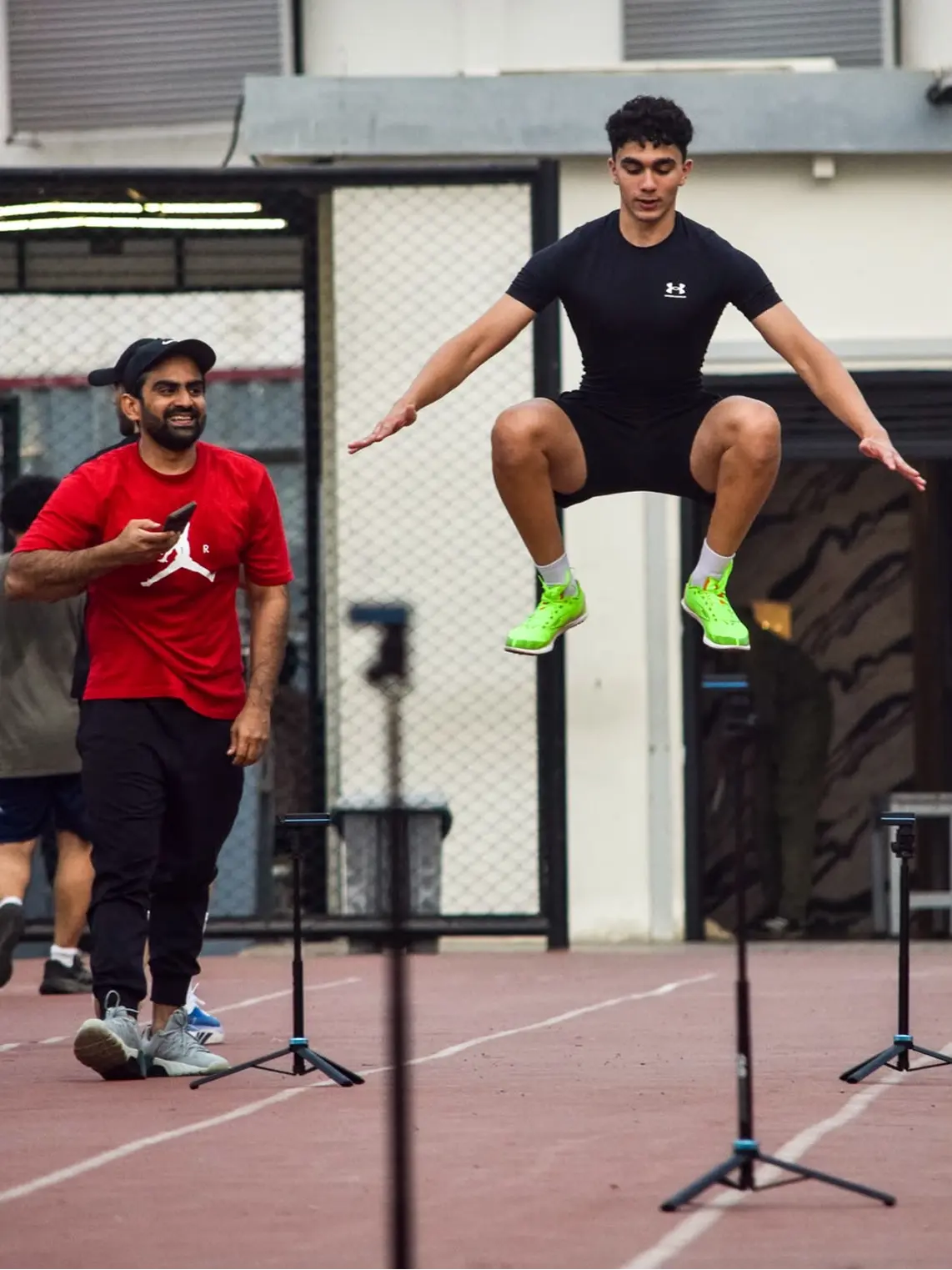
A birth certificate is the least useful thing we know about a child.
Two thirteen-year-olds in the same team can be three or four years apart biologically. One is already through their growth spurt, carrying adult levers and adult force. The other has not started. They are selected against each other, trained identically, and judged by the same standard, and it is close to meaningless.
So we do not group children by age. We group them by what their bodies are actually doing, and we estimate that from measurements taken in the first ten minutes of the assessment. There are two bands, and the reason they exist is biological, not administrative.
Ages 8 to 11
Before the growth spurt
This is the fastest period of nervous system development a person will ever have, and it closes. Coordination, speed, agility and skill are more responsive now than they will be at any later point, and a child who does not build them here spends the rest of their athletic life catching up.
Body proportions are also relatively stable, which means movement is genuinely learnable. Strength gained at this age comes almost entirely from the nervous system rather than muscle size, so the work is bodyweight, landing quality, sprinting and technical competence. Heavy load would add nothing that the nervous system is not already giving for free.
What we look for: how well they land, how they produce force, whether one side is doing more work than the other, and whether the basic movement is there to build on.
Ages 12 to 16
Through and after the growth spurt
During the fastest phase of growth, bone lengthens before muscle and tendon adapt to it. Coordination temporarily degrades, which is real and measurable and not a discipline problem. Injury risk rises sharply at the knee, the heel and the growth plates, and this is precisely when a talented child is most likely to be given more training rather than more care.
It is also the window when genuine strength and power development becomes possible, particularly after the peak of the growth spurt has passed. So the training has to change during this band, not on a birthday, and knowing where a child sits inside it is the whole point of measuring.
What we look for: where they are relative to their own growth peak, whether force production has caught up with their new levers, and any left-to-right gap that a rapidly changing body has opened up.
WHAT WE WILL NOT DO TO A CHILD
No maximum lift is ever attempted, at any age. No high-impact jumping is prescribed before the landing quality that protects it has been earned and demonstrated. We will not tell you your child should specialise in one sport early, because the evidence does not support it and the injury and dropout data actively argue against it. A physician screens before anything is measured, and anything that concerns him stops the session. That is a duty of care, and it does not negotiate with a fixture list. Nothing clinical about your child is ever published.
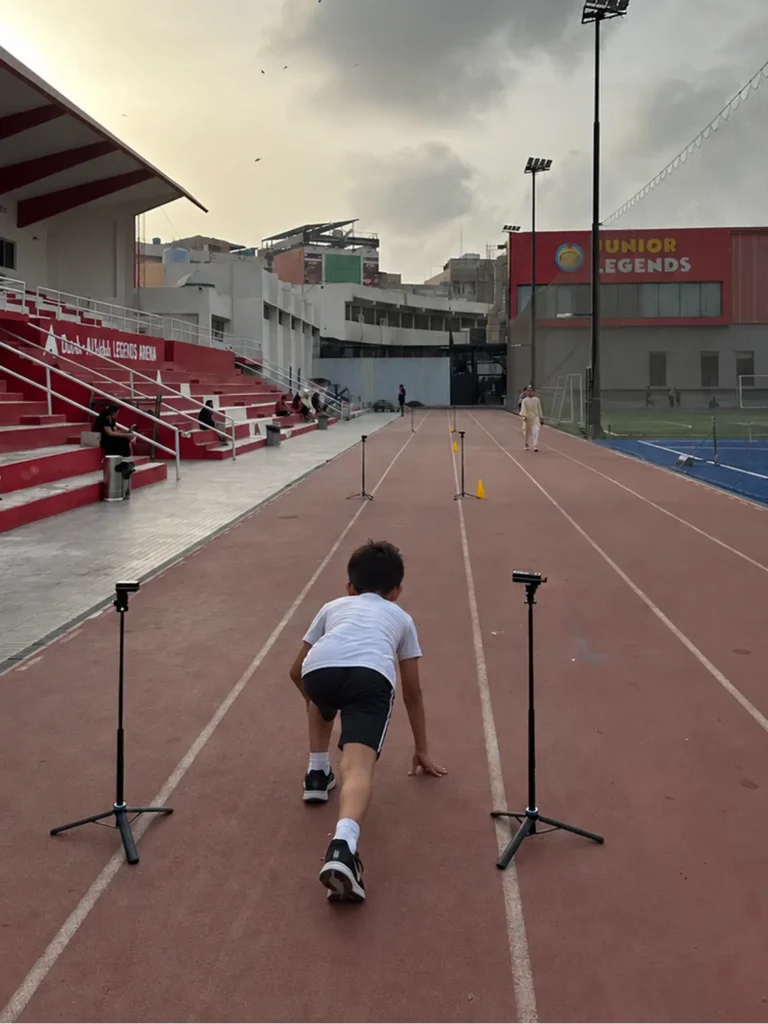
The qualities that decide your seventies are measurable in your fifties.
Strength, power, grip and balance are not athletic vanity. They are the four things that determine whether you carry your own shopping, get off the floor unaided, recover from a stumble instead of falling, and stay in your own home.
All four decline quietly and predictably, and all four respond to training at any age. The only real question is whether anyone has measured yours, and whether you would rather find out now or find out from a fracture.
Grip strength is one of the most predictive numbers in medicine
Across decades of research and across populations, grip strength independently predicts all-cause mortality, cardiovascular mortality, disability and age-related muscle loss. It takes ninety seconds to measure and almost no one over fifty has ever had it done.
How fast you walk predicts more than most blood tests
Habitual walking speed is among the strongest single predictors of healthy ageing and mortality that exists. So is the time it takes you to rise from a chair five times without using your hands. These are not soft measures. They are validated clinical instruments, and they are part of this assessment.
Power matters more than strength for staying upright
Strength is how much force you can produce. Power is how fast you can produce it, and it is power that decides whether you catch yourself when you stumble. Power declines earlier and faster than strength with age, and it is the quality most often missed entirely in training for older adults.
We measure it, safely, through the speed of the bar under light load. A fit older adult can and should train fast.
Two people, two completely different assessments
If you already train, you are assessed close to the way an athlete is: real jumps, a submaximal strength ramp, genuine loading. Being sixty-five is not a reason to be handed a chair test.
If you are returning to activity, or if screening shows functional limitation, you are assessed on validated functional measures instead: sit-to-stand, gait speed, timed up-and-go, and a graded balance series. Nothing is dropped. The tests are substituted for the ones that actually discriminate in your range. The physician decides which path on the day, after screening, not from a form.
Your results are compared against people like you
Most published reference values come from Western populations. Where better matched data exists, including for Asian community-dwelling adults, we use it, and every number in your report names the group it is compared against.
ONE HONEST THING ABOUT THE TIMELINE
The falls-prevention benefit in the research does not come from eight weeks of anything. It comes from roughly fifty cumulative hours of progressive strength and balance work. Meaningful change needs at least twelve weeks, and the real benefit accrues over years.
So this is a long relationship, not a course. We will measure you, programme for what we find, and retest so the change is proven. What we will not do is tell you that two months will secure your independence, because it will not, and you deserve to be told that at the start rather than sold it.
Before the numbers, one thing
A measurement is not a verdict.
Most people are quietly afraid of being measured. They assume a low result says something about who they are. It does not. It is a position on a range, on one morning, against a named group of other people. That is all a percentile ever is, which is why every number on your report tells you exactly which group it is being compared against. A percentile without its reference group is not information.
And there is one thing we are looking for above all others: your limiter. The single quality that, if it improved, would move your performance the most.
Almost nobody is limited by everything. Most people are limited by one thing, and have spent years training around it without knowing it was there. Finding it is the point of the session.
The programmes
One diagnostic. Four ways to act on it.
Everything starts with the same measurement, because there is no honest way to prescribe without one. Where you go afterwards depends on how much of the work you want to own yourself. Every programme runs over two months and closes with a full retest, so what changed is measured rather than assumed.
Start here: the Performance Diagnostic
Your full profile across all eight qualities, with the Performance Signature report and a face-to-face debrief. Ninety minutes. It stands alone, and plenty of people take the report and use it with their own coach.
PKR 15,000
one session
Then choose how you want the work done
Programme
What it is
PKR
Runs
Performance Foundation
A baseline diagnostic, a guided programme you run on your own, and a full retest to close. Gym membership not included.
35,000
Self-paced
Performance Group
Small-group coaching, maximum eight per coach. Three sessions a week, two in the studio and one on the field. Fully instrumented on the same eight qualities, with measured change across the block.
80,000 per person
2 months
Performance Semi-Private
Two to five people. Three to four sessions a week, fully instrumented and data-driven, closing with a full retest.
150,000 per person
2 months
Performance 1-on-1
The complete bespoke programme, built on your profile alone. Fully instrumented and data-driven, closing with a full retest.
200,000
2 months
Performance Foundation
A baseline diagnostic, a guided programme you run on your own, and a full retest to close. Gym membership not included.
PKR
35,000
Runs
Self-paced
Performance Group
Small-group coaching, maximum eight per coach. Three sessions a week, two in the studio and one on the field. Fully instrumented on the same eight qualities, with measured change across the block.
PKR
80,000 per person
Runs
2 months
Performance Semi-Private
Two to five people. Three to four sessions a week, fully instrumented and data-driven, closing with a full retest.
PKR
150,000 per person
Runs
2 months
Performance 1-on-1
The complete bespoke programme, built on your profile alone. Fully instrumented and data-driven, closing with a full retest.
PKR
200,000
Runs
2 months
Semi-Private and 1-on-1 include a two-month Legends gym membership, one complimentary wellness session each month, and any additional wellness sessions at a reduced rate. Each wellness session includes the steam room, jacuzzi and cold plunge.
Performance Group is coaching only: two studio sessions and one field session each week. It does not include gym membership or gym floor access outside those sessions.
Foundation exists to answer one question honestly: can you execute a good programme on your own? Some people can. Most discover at the retest that they cannot, and that is not a failure of the programme, it is the most useful thing they will learn all year. We do not supervise your training in Foundation and we do not claim to own the result. The retest tells you what actually happened, whatever you did.
Who runs the session
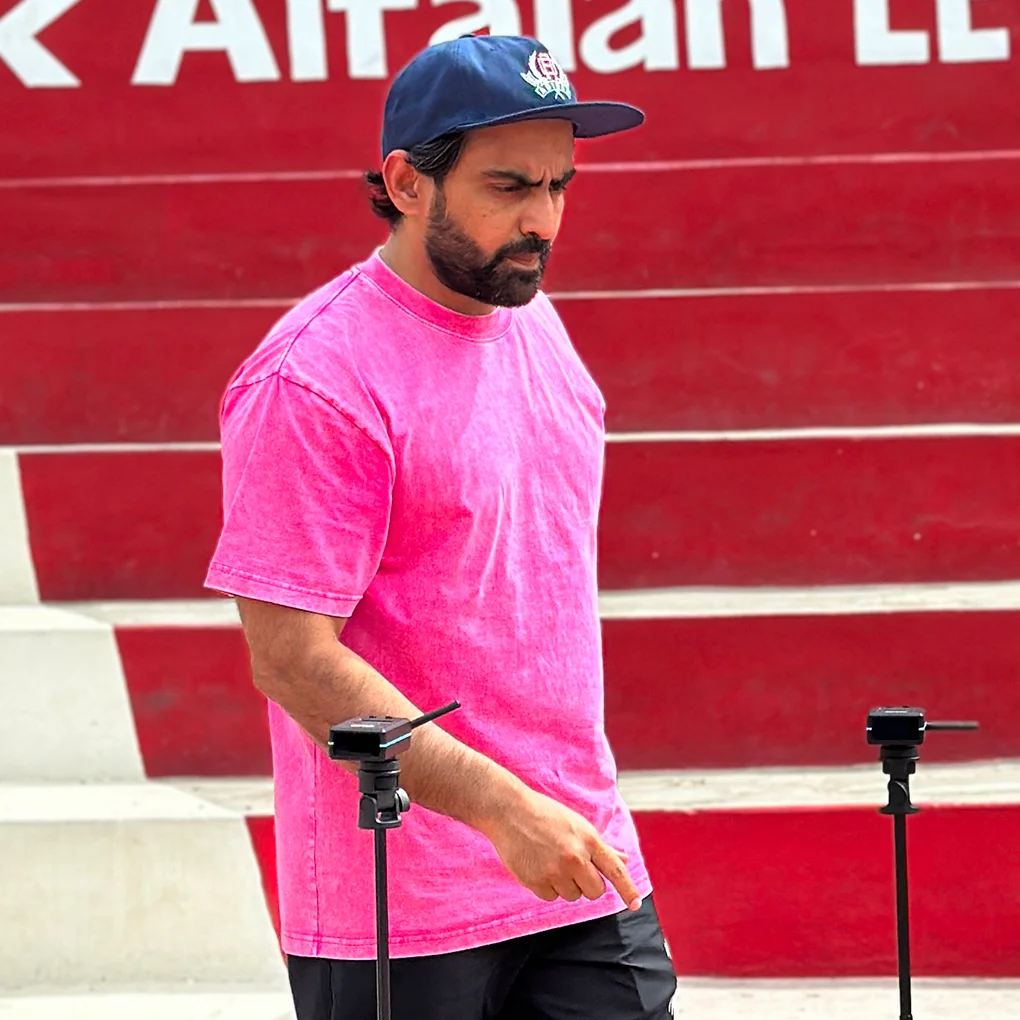
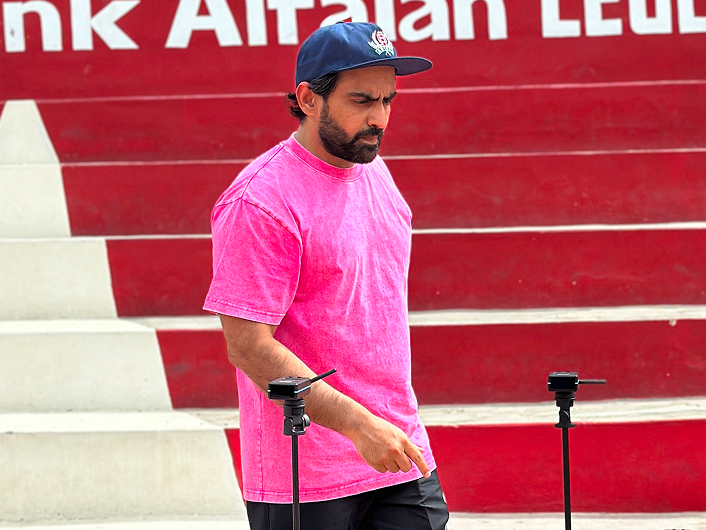
Dr. Muhammad Ahmed Siddiqui,MBBS, MPH, Johns Hopkins
Dr. Siddiqui holds an MBBS from Sindh Medical College, Karachi, and an MPH from the Johns Hopkins Bloomberg School of Public Health. He is a public health physician with more than fifteen years across USAID, UNICEF, Gates Foundation and DFID-funded programmes, a peer-reviewed published researcher, and a competitive strength athlete.
He leads Legends Performance, and he runs the diagnostic personally.
That last sentence is the product. The person interpreting your results is a doctor, the screening that happens before anything is measured is clinical screening, and the duty of care that comes with it is not optional. It overrides the schedule and it overrides what you would prefer to hear.
Measure the whole squad. Then coach the actual gaps.
Most squads are trained as one body because nobody has the data to do anything else. Profile the squad and the picture separates immediately: who is limited by force, who by reactive quality, who by deceleration, and who is carrying a left-to-right gap that will become an injury before the season ends.
We work with clubs, academies, schools, universities and corporate programmes. Individual reports for every athlete, one summary for the coaching staff. Arranged directly, and priced against squad size and the testing window.
Common questions
Do I need to be an athlete?
No. The tests measure qualities every human body has. What changes between a national sprinter and a forty-five-year-old who plays padel twice a week is the interpretation and the training priority, not the assessment.
Is this going to hurt, or is it dangerous?
No. Nothing in the session is taken to failure and no maximum lift is ever attempted. You are screened by a physician before anything is measured, and anything that concerns him stops the session rather than being worked around.
What if my numbers are bad?
Then you will have found out something true, early, from someone who can tell you what to do about it. Every result is a position on a range on one morning, and the range names the group it is drawn from. Nothing in the report is a grade and nothing in it is a judgement.
Can you guarantee I will improve?
No, and be careful of anyone who does. Adaptation is individual, and some well-trained people show very little change in a given quality over eight weeks. What we promise is the process: we measure, we build the programme around what we found, and we measure again so the change is proven rather than assumed.
How long does it take and what do I need to bring?
About ninety minutes including the debrief. Bring training kit and the shoes you normally train in, and come reasonably rested. Do not train hard that morning, or you will be measuring your fatigue rather than your capability.
How is this different from what my gym already does?
A gym assesses you to sell you a programme. This measures you to find out what is actually limiting you, using instrumentation, and then tests you again at the end to see whether it worked. If your gym runs timing gates, a jump mat and a velocity sensor, and closes every block with a retest against your own baseline, you are already in good hands.
Do I have to buy a programme afterwards?
No. The Diagnostic stands alone and plenty of people take the report and use it with their existing coach. That is a completely legitimate outcome and we will write the report the same way either way.
What happens to my data?
Your report is yours. Anything clinical stays in your private record and is never published, whatever you consent to. Legends is building the first normative performance dataset for the Pakistani population from these assessments, and any use of your data for that purpose is anonymous and only with your agreement.
You have read enough to know whether this is for you.
There is no helpdesk and no call centre. Write to me directly, tell me what you play or what you are training for, and what you are trying to find out. I will tell you honestly whether the diagnostic will help you and which programme, if any, makes sense afterwards.

